You have probably seen the adverts by now. Type a few sentences about your business, click a button, and an artificial intelligence will build your entire website while you make a cup of tea. It sounds brilliant, especially if you hate faffing with technology.
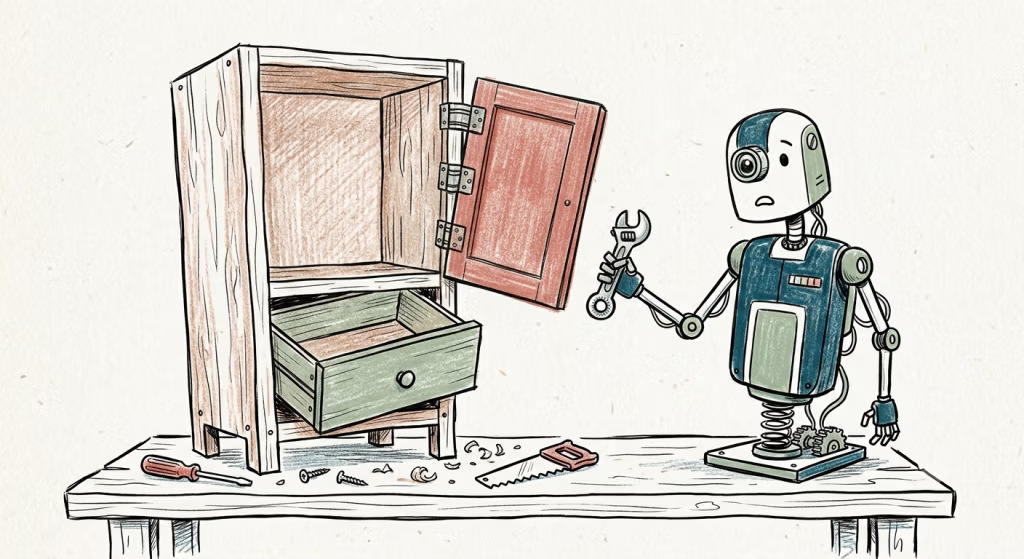
The problem is what happens after those three minutes. That is when the website stops being magic and starts behaving like a half-finished, flat-pack kitchen. It looks mostly right, but every cupboard door hangs slightly off, the drawers stick, and you are suddenly spending evenings fixing problems you thought you had paid to avoid.
The dream: AI builds the site while you relax
On paper, AI website builders solve a real frustration. No code. No hiring developers. No long calls about wireframes. You answer a few questions, pick a style, and an instant site appears. For a busy small business owner, that is very appealing.
Modern AI builders genuinely can throw together a layout, colour scheme, stock photos, and pages in minutes. Some even claim to sort the search engine optimisation and the technical bits for you. The pitch is clear. You will never need a web designer again. Your website will look like the examples in the advert and it will all just work.
But when people come to us after trying those tools, the story is usually the same. The site looked surprisingly decent at first. Then the problems started to show.
The hidden reality: you become your own web department
AI builders are sold as “no effort”. In practice they turn you into the web department. You still have to write or at least approve the content. You have to check whether the pages say the right things, whether your services are clear, whether the images actually fit your brand. You have to decide what goes in the navigation, which pages exist, and how people will contact you.
Underneath the shiny interface, the builder has not magically understood your business. It has generated a generic version of “a plumber”, “a hairdresser” or “a consultant”. You then spend hours reshaping that template into something that matches your reality. That is real work. For many people, it is exactly the kind of work they wanted to avoid.
Then there is the boring but essential stuff. Cookie notices. Contact forms that actually send to the right inbox. A dozen other small things like legal pages, analytics and email signups. None of that disappears when AI is involved. Someone still has to think about it and test it. On AI builders, that someone is usually you.
Bugs everywhere and nobody checking properly
When you build a site professionally, there is a boring but critical phase at the end. Every single element, every word, heading, image, button, section and page is checked on multiple devices and browsers. Desktop, laptop, tablet, several sizes of mobile. Different operating systems. Different connection speeds. Problems are fixed before launch so visitors never see them.
Audits of AI-built websites show that this kind of thorough quality assurance is almost never happening. Under the surface they find broken heading hierarchies, missing meta tags, unlabelled sections, and pages that technically exist but are invisible to search engines. Brambla’s 2025 review of AI-generated sites found that many looked fine at a glance but had thin content, poor heading structure and slow performance that caused them to rank badly or not at all.
Growth Solutions Agency’s audits of AI website builders found the same pattern over and over. Div soup instead of proper HTML structure. Navigation made from clickable anonymous boxes instead of readable links. No landmarks for screen readers. JavaScript bundles far larger than necessary for simple pages. When tested with accessibility tools and performance scanners, these sites failed most objective quality checks even though the designs were visually slick.
AI builders optimise for “looks ok on the screen right now”. They rarely sit with three different phones checking your contact form in landscape and portrait, or check whether your call to action still works when the keyboard pops up on screen. That still needs a person who cares about the details.
When you finally hire a freelancer, the robot code fights back
There is another catch that only appears later. At some point a nagging bug will annoy you enough that you hire a freelancer or agency to fix it. Maybe the mobile menu is broken. Maybe the contact form works on desktop but not on your phone. Maybe the layout snaps in half on tablets and you are tired of explaining to customers how to find things.
If that bug lives in a site that was built in a normal, human way, a developer can usually fix it in half an hour. They will read the code, see how the layout is structured, change the relevant bit and move on. When the same bug lives in a site built by an AI, the job is often completely different.
A large-scale study of human written vs AI generated code shows that it looks neat at the level of individual functions but becomes messy and inconsistent when you zoom out. AI tools tend to duplicate patterns, mix different architectures, and create many slightly different solutions to the same problem in the same codebase. They produce code that is repetitive and more prone to unused and confusing constructs.
Content, layout and behaviour might be glued together in a way that makes sense to the model but not to a human. Tianpan’s engineering analysis described it as high local coherence and low global consistency. It looks clean in small pieces, but the overall structure does not follow a clear design philosophy.
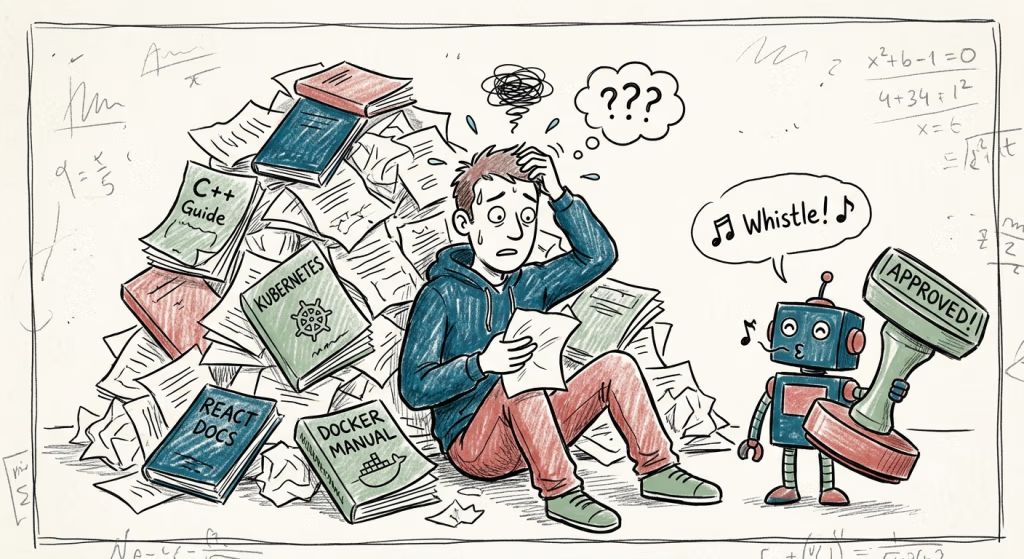
That is why fixing an AI-built site can take hours instead of minutes. The freelancer has to reverse engineer the robot logic first. It is like being handed a thick manual written partly in English and partly in Italian, with no index, and being told “the problem is somewhere in chapter five”. They spend most of their time figuring out what the AI was trying to do before they can safely touch your specific bug.
Articles on AI-generated software maintenance warn about exactly this problem. AI can write code quickly, but maintaining it is harder because it lacks business context, uses inconsistent styles, and often introduces security and readability issues that humans then have to unravel.
Why the SEO quietly falls apart
Even if the site mostly works for visitors, search engines usually see a different story. Several independent audits of AI-built websites in 2025 and 2026 found consistent patterns.
Blue Avispa’s long form study of AI-built business sites reported that these pages frequently had thin, generic content that did not target specific search queries. Heading tags were misused. Meta titles and descriptions were duplicated or vague. Core Web Vitals scores were poor, especially on mobile. Structured data was missing entirely. In many cases, the sites looked respectable but simply did not rank for anything useful.
Webvalid’s analysis of AI websites found that “unguided” AI content did noticeably worse in Google. Pure AI copy tended to rank lower, had a higher risk of pages being removed from the index, and lacked the signals of expertise and trust that modern search algorithms look for. Technical checks on AI-built sites repeatedly found missing schema, broken heading structures, and weak internal linking.
SEO focused articles from agencies that tested AI builders in the wild describe similar stories. AI tools were good at producing a visually acceptable homepage, but often produced filler content just to make pages look full, without any real depth or unique value. They were more likely to create repetitive phrasing across sites, which increases the risk of being treated as low quality or duplicate content.
The AI is trained to make something that looks like “a website for a business like yours”. It is not trained to understand what your specific potential customers are typing into Google, how competitive those queries are, and which technical tweaks will push your pages into view. That still requires human thinking and ongoing care.
The invisible, mediocre website problem
There is an even more brutal failure mode that does not show up on the pricing page. Some AI builders ship sites that search engines can barely see at all.
A detailed audit of popular AI website builders in 2026 found that many generated single-page applications where most of the content was rendered entirely in the browser with JavaScript. To a visitor on a modern laptop that can look fine. To Googlebot, which initially sees an empty page with a single “root” div and a script tag, it can look like there is no content to index. For competitive searches this is disastrous.
The same audit found that these AI-generated sites often had no structured data, weak or missing meta tags, bloated CSS, and large JavaScript bundles for very simple layouts. Accessibility checks showed dozens of critical and serious issues per page. Lighthouse performance scores for these AI-generated sites were routinely under fifty for mobile.
Webvalid’s article called this the double payment trap. First you pay for the AI builder and feel clever when your site appears quickly. Then six months later you pay again, often much more, for someone to rebuild the whole thing properly because the invisible technical problems are hurting your traffic and trust.
The “AI tells” that make visitors mistrust you
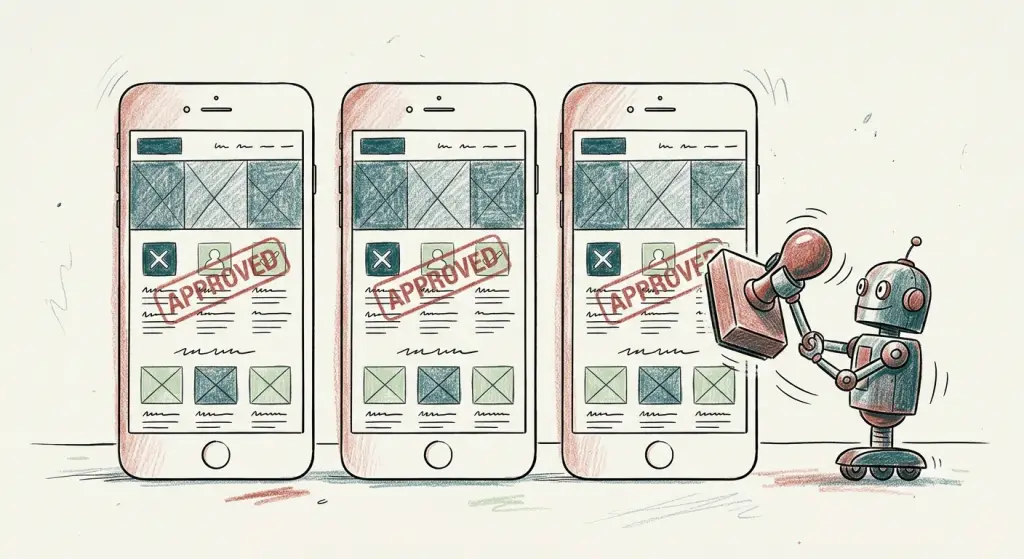
Visitors are not stupid. They might not be able to quote the version of the framework used on your site, but they increasingly recognise the “AI look”.
There are already browser extensions whose entire job is to detect AI-generated websites by spotting visual and content patterns. The Vibe browser extension scans for common traits like purple or blue gradients everywhere, generic taglines, placeholder style testimonials, card layouts with identical hover effects, missing meta tags, and other easy to recognise signals. It then gives the site a confidence score for being AI generated.
The Impeccable AI slop catalogue lists thirty seven visible rules that mark an interface as AI generated. It lists repeated uses of the same few gradient styles, overly glossy glass effect cards, slightly uncanny illustrations, strange combinations of fonts, awkward spacing, and responsiveness mistakes that show parts of the layout were never properly tested.
Individually these things are minor. Collectively they create what some designers now call “AI slop”. A kind of uncanny sameness that makes a site feel cheap, temporary and untrustworthy.
Using AI for a single headline or one supporting image is one thing. Building an entire website that feels auto generated from top to bottom is another. For some customers, that makes the whole business seem here today and gone tomorrow. A site that feels like an anonymous template can undermine the credibility you have worked hard to build in the offline world.
AI is useful when it is the assistant, not the architect
None of this means AI is useless. It means the role matters.
When developers and designers use AI inside their own tools, they get the best of both worlds. AI can generate boilerplate code and first pass layouts in minutes. Humans then review, test, and refine. Studies of teams using AI this way show faster builds without losing quality, because experts are still making the architectural decisions and catching the subtle issues.
AI can be brilliant for brainstorming page ideas, sketching a rough structure, or writing a first draft of content that a human then edits heavily. It can help non writers overcome blank page syndrome. It can suggest alternative headlines or explain concepts in simpler language.
The problems begin when AI is expected to replace the job of a web team entirely. Unguided AI tries to design, write, develop, test and optimise all in one go. That is where generic content, fragile layouts, and invisible technical debt creep in.
For personal projects, prototypes and internal tools that will never need to rank or convert strangers, this might be acceptable. For a real business that relies on its website for leads and sales, it is a risky bet.
Why so many people end up choosing a managed site instead
This is why so many small business owners eventually come back from the “AI built my site” experiment. They did not actually want a new hobby in debugging JavaScript, wrestling with heading tags, or interpreting search console messages. They wanted someone else to worry about it.
Working with a human web team, especially on a low cost pay monthly basis, changes the shape of the problem. You are no longer alone with a mysterious interface and a support bot. You have people whose job it is to care about your site. They think about your structure, your forms, your emails, your analytics and your search presence while you think about your business.
You can have your automation workflows designed and implemented for you, instead of wrestling with generic tools. Someone actively checks and adjusts your technical SEO over time, rather than you hoping the AI builder got it right. Bugs get caught by a team testing across devices before launch, not discovered on your phone by a customer.
Most importantly, you are not locked into a single auto generated template that thousands of other businesses are using. Your site can reflect your real story, with content and design that feel like they belong to you, not to a model trained on everybody else.
A website is not a one click magic trick
It is very tempting to believe that one click can replace a whole web department. The marketing makes it sound that way. In reality, a website is an ongoing relationship between your business, your customers and the boring but important technical layer underneath.
AI is a powerful tool inside that relationship, as long as it is treated like an assistant rather than a replacement. The more the builder tries to tell you “you will never need a human again”, the more you should ask who will be fixing the bugs, maintaining the code, and protecting your reputation when the novelty wears off.
For many businesses, the most relaxing button to press is not “build my site with AI”. It is “let someone else be my web team”. That way your website can use smart tools where they genuinely help, but you are never left alone to decode robot mistakes at midnight.
Further reading and sources
If you want to dig into the data behind these points, here are some useful articles and studies:
Why AI built websites struggle with SEO
Are AI websites bad? The honest truth in 2026
Why AI website builders kill your SEO
AI website builder quality reality
Human written vs AI generated code a large scale study
The AI generated code maintenance trap